Lukas
Sonne und BetonLukas’s defining tension in these scenes is between insisting that he can manage things himself and repeatedly finding himself trapped by consequences he cannot control. He talks his way toward school, weighs whether to use a weapon in a confrontation, and joins a plan to steal computers; when the theft becomes a matter of police attention and possible exposure, he panics and prepares to conceal evidence. His account makes that tension immediate: the reader encounters each crisis through his first-person narration, including the bodily strain and hurried self-justifications that complicate his claims of control.
Identity and Introduction
At the school entrance, Lukas argues with a security guard who will not let him in. He says he has attended the school for four years, that he and the guard have seen each other countless times, and that he has forgotten his student ID only this once. Familiarity and insistence do not alter the guard’s response. The scene establishes Lukas as someone who expects recognition to count for more than a rule, and who meets an impersonal boundary with pleading, profanity, and repeated assurances.
That opening also introduces the pressure of rules into his daily life. Lukas does not dispute that he forgot the ID; instead, he argues that his usual compliance and his history at the school should earn an exception. His appeal is practical rather than reflective: he wants to get inside now. The episode offers no account of what the school ultimately does about his entry, but it gives his first response to authority in these excerpts—talk fast, make the case personal, and push for a way through.
Violence, Loyalty, and Self-Reliance
In another confrontation, Lukas considers whether to strike a man while Cem and Cem’s older companions are present. He fears that a conversation between the two sides might expose that Julius has insulted each of them separately; to Lukas, that possibility is worse than simply trying to hit the man and trusting Cem’s group to help. His immediate concern is not only the threat of a fight but the risk that conflicting stories will become visible.
Gino suggests calling Marco. Lukas rejects the idea: Marco would not arrive before the situation was over, and Lukas says he cannot always call on his brother. The refusal reveals a limit in the protection he is willing to seek. He insists that he has done nothing and that the other man deserves to be hit, then extends a Telescopic Baton, taps its tip against his palm, grips it harder, and clenches his free hand. His body moves toward violence as his reasoning supplies a justification for it. Before he reaches the man, however, the group stops; Cem offers cigarettes and speaks in Turkish to his companions. The excerpt leaves Lukas waiting to learn what that pause means, rather than showing the confrontation resolved.
The School Theft
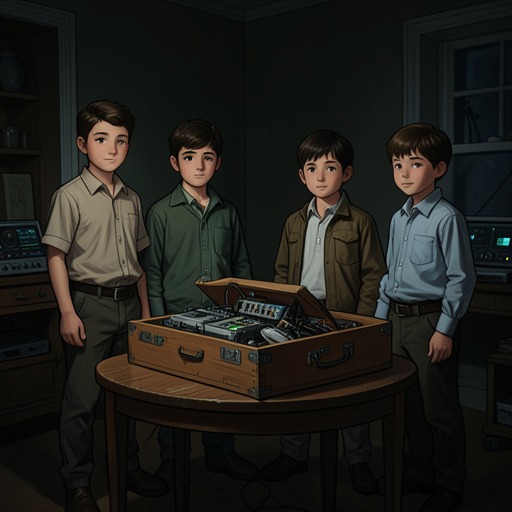
Lukas is present when a plan is proposed to steal fifty brand-new computers from the school, along with their screens, keyboards, and mice, and sell them for money. Julius and Gino grin at the prospect. Lukas responds with disbelief, asking whether the proposal is serious. The contrast matters: he registers the plan’s audacity even as the conversation places him among the people considering it. In these scenes, his skepticism does not amount to a refusal; later, the police briefing and his fear about the stolen machines show that the burglary has become a danger he understands from the inside.
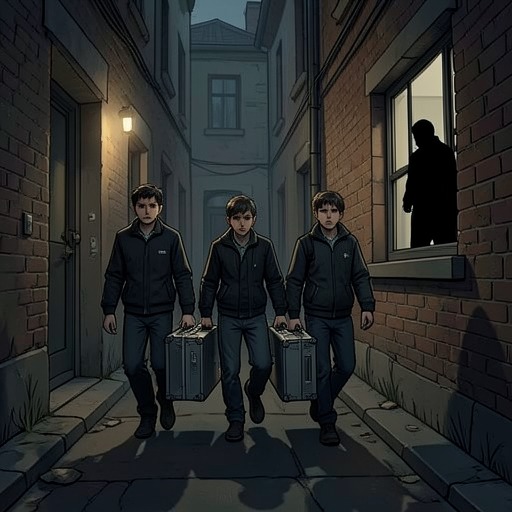
When the Berliner Polizei addresses his class, officers say the school was broken into over the weekend and that computers and monitors worth several thousand euros were taken. According to residents, three male suspects in black hooded jackets carried the stolen goods in a shopping cart toward U-Bahnhof Zwickauer Damm. The officers say they do not yet know how the burglars entered the school. They also report that shots were heard near the station that same evening, while making clear that the connection between the gunfire and the burglary is not established. The public account turns the theft into a set of clues; Lukas, under Herr Schiezeth’s gaze, experiences it as an accusation closing in. He looks down and thinks he should have stayed home like Sanchez.
The class falls unusually quiet after the report. Momo murmurs about the several thousand euros the thieves must have made, and Lukas manages only a forced smile. That small reaction contrasts with the excitement of easy money: once the crime is being discussed at school, its scale is no longer just an imagined reward. It is also a public event whose details may lead back to the people who know what happened.
Exposure and Panic
Later, while shopping with Sanchez, Lukas receives a call from Momo. At first the shop’s basement has no reception, so Lukas goes outside and answers when the phone rings again. Momo jokes about Lukas being on vacation and not wanting to go to school, then says that he is dying of boredom. The available exchange does not explain what Momo knows about the burglary. What it does show is how abruptly an ordinary call can become part of Lukas’s sense of danger: after the conversation ends, he stares at his phone and erupts into a string of curses, blaming Taner, the computers, Julius, and Sanchez.
Lukas’s next thoughts make the stakes plain. He fears that even if nobody immediately informs on the group, a teacher will eventually find out and go to the police. He decides that the remaining computers must be thrown away because, without them, the authorities will have no evidence. This is not a plan to repair the harm or come clean; it is an attempt to prevent the stolen goods from proving anything. His panic is expressed physically as well as verbally: he hits his head with his phone, looks around frantically, takes a deep breath, and hurries back down the stairs to Sanchez, who is paying for his trousers. He struggles to explain that they need to deal with something, stammering as he tries to pull Sanchez away from the ordinary business of the purchase.
Silence and Narrative Role
At school, Herr Reinicke eventually asks Lukas directly what he has to say about the stolen computers. Before the question, Lukas sinks to the floor beside the office, rests his head on his folded arms, and describes the situation to himself as a mess. When Herr Reinicke finds him, Lukas nods without speaking and stands. He tells himself to remain calm, listen, and say nothing, adding that Marco will think of something. The earlier rejection of calling Marco and this renewed reliance on him form a revealing contrast: Lukas says he cannot always summon his brother, yet when a teacher confronts him, he again places hope in Marco’s ability to devise a solution.
Herr Reinicke sits at his desk and looks Lukas in the eyes without blinking as he asks about the computers. The available scene stops at the question, so it does not establish whether Lukas confesses, denies involvement, or remains silent. That unresolved ending preserves the central pressure of his account: his own knowledge, his fear of evidence, and his practiced impulse to evade consequences have brought him to a direct test of what he will say. Through the first-person narration, the gap between his claims of innocence and his urgent efforts to hide the computers is visible without needing an outside accusation to spell it out.